
Coliving in Asia-Pacific: Market Overview and Opportunities

Recommended Tools
Free interactive tools related to this article.
Coliving Readiness Index
Assess your readiness across 11 critical coliving business factors.
Try it free →Market Demand Estimator
Estimate coliving demand in your target market.
Try it free →ROI Calculator
Estimate potential returns and payback periods for coliving.
Try it free →Investor Pitch Generator
Generate an investor pitch outline with financial projections.
Try it free →Coliving in Asia-Pacific: Market Overview and Opportunities
Asia-Pacific represents the fastest-growing coliving market globally, driven by rapid urbanization, soaring housing costs, and a cultural openness to shared living that does not exist in many Western markets. For operators and investors looking beyond North America and Europe, APAC offers compelling opportunities and unique challenges.
Market Drivers
Urbanization at Scale
Over 60% of the world's urban population growth through 2030 will occur in Asia-Pacific. Cities like Jakarta, Manila, Ho Chi Minh City, and Bangalore are adding millions of residents who need affordable, well-located housing.
Housing Affordability Crisis
Housing price-to-income ratios in major APAC cities are among the highest globally. Hong Kong, Singapore, Sydney, and Tokyo are consistently ranked as the least affordable housing markets. Coliving offers a compelling alternative for young professionals priced out of traditional housing.
Cultural Compatibility
Unlike Western markets where shared living can carry stigma, many Asian cultures have existing traditions of communal and multigenerational living. This cultural familiarity reduces the adoption barrier.
Remote Work Adoption
While slower to adopt remote work than Western companies, APAC businesses are increasingly embracing hybrid models. This creates demand for flexible living arrangements that combine home and workspace.
Key Markets
Singapore
The most mature coliving market in APAC. Strong regulatory support, high demand from expatriates and young professionals, and premium pricing make it attractive for operators. Average monthly rents for coliving range from $1,200-2,500 SGD.
India
The largest market by volume with significant growth potential. Focus cities include Bangalore, Mumbai, Delhi NCR, Hyderabad, and Pune. The market is driven by young professionals and internal migration to tech hubs. Pricing is more accessible, typically $200-600 USD per month.
Japan
Tokyo and Osaka have established coliving scenes, with "share houses" being a familiar concept. The aging population creates opportunity for senior coliving concepts. Regulatory environment is favorable.
Australia
Sydney and Melbourne are primary markets. High housing costs and a strong international student and young professional population drive demand. Operators face higher construction and labor costs but can command premium pricing.
Southeast Asia
Thailand, Indonesia, Vietnam, and the Philippines are emerging markets with strong digital nomad demand. Lower operating costs and growing domestic middle classes create diverse opportunity. Bali has become a global coliving hub.
South Korea
Seoul's housing market pressures and a tech-savvy young population create natural demand. "Co-living" is increasingly recognized as a housing category, and several domestic operators are scaling.
Investment Landscape
Venture Capital Activity
APAC coliving startups have attracted significant venture funding. India leads in deal volume, while Singapore-based operators attract the largest individual rounds.
Institutional Interest
Real estate investment trusts (REITs) and institutional investors in Singapore, Japan, and Australia are beginning to allocate to coliving as a distinct asset class.
Returns
APAC coliving investments typically yield 2-4% above comparable residential assets, reflecting the management premium. Net yields of 5-8% are common for well-operated properties.
Challenges
Regulatory Complexity
Each country, and often each city, has different regulations around density, short-term stays, and shared housing. Navigating this patchwork requires local expertise.
Cultural Nuances
While shared living is culturally familiar, expectations vary significantly. Privacy norms, gender separation requirements, and community engagement styles differ across markets.
Fragmented Markets
APAC is not one market. It is dozens of distinct markets with different languages, currencies, regulations, and consumer preferences. Scaling requires a localized approach.
Currency Risk
For international investors, currency volatility adds a layer of risk. Hedging strategies and local currency debt can mitigate this.
Opportunities for Operators
- Student coliving in India and Southeast Asia: Large, underserved market with consistent demand
- Senior coliving in Japan: Aging population with strong purchasing power
- Digital nomad hubs in Southeast Asia: Build on existing demand in Bali, Chiang Mai, and emerging destinations
- Corporate coliving in Singapore and Australia: Serve companies relocating employees
- Technology-first models across the region: Mobile-first populations are ready for app-driven coliving experiences
Getting Started
If you are considering APAC expansion, start with a single market where you have existing connections or knowledge, partner with local operators for market entry, budget 6-12 months for regulatory navigation, and build relationships with local real estate players before committing capital.
APAC is not a market you can enter casually, but for operators willing to invest in understanding local dynamics, the growth potential is unmatched.
You Might Also Like
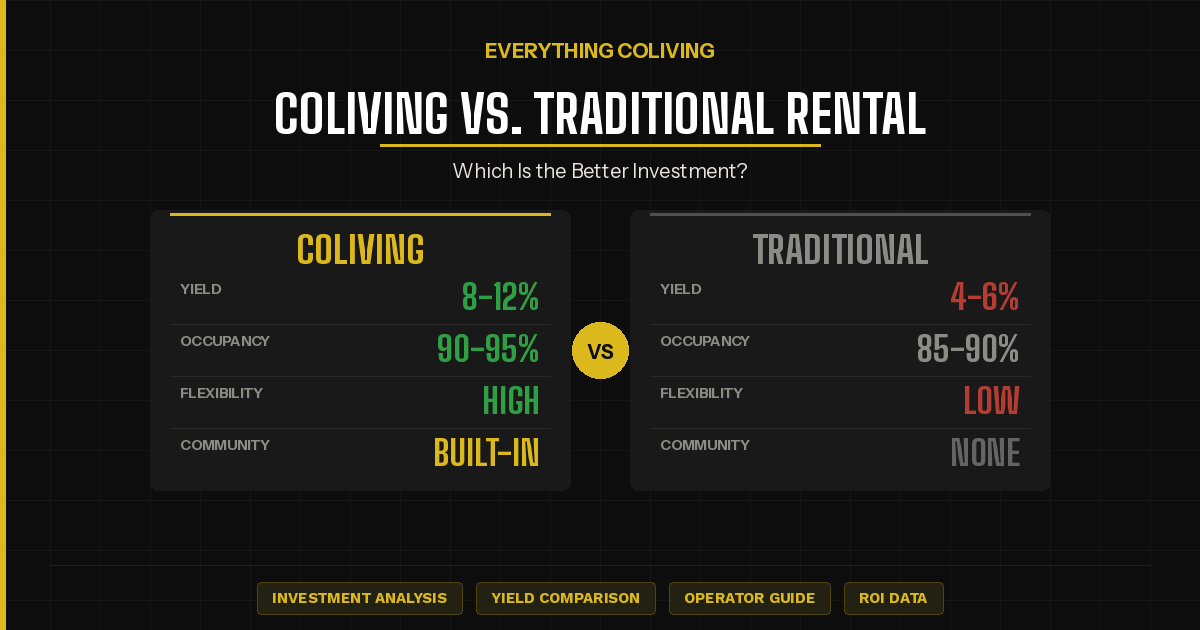
Coliving vs. Traditional Rental: Which Is the Better Investment?
Compare the financial returns, risks, and operational demands of coliving investments against traditional buy-to-let properties.
March 8, 2026
Coliving in Berlin 2026: The Complete Market Guide
Berlin's coliving market is one of the most dynamic in Europe. Our guide covers market size, pricing, top neighborhoods, regulatory landscape, and the best spaces.
December 23, 2025

When to Scale Your Coliving Business: Signs You Are Ready to Expand
Scaling too early kills coliving businesses. Learn the financial, operational, and market signals that indicate you are ready to open your next property.
January 25, 2026