
Coliving vs. Traditional Rental: Which Is the Better Investment?
Recommended Tools
Free interactive tools related to this article.
Coliving Readiness Index
Assess your readiness across 11 critical coliving business factors.
Try it free →Market Demand Estimator
Estimate coliving demand in your target market.
Try it free →ROI Calculator
Estimate potential returns and payback periods for coliving.
Try it free →Operating Budget Template
Build a comprehensive operating budget for your property.
Try it free →Coliving vs. Traditional Rental: Which Is the Better Investment?
Real estate investors increasingly face a choice: stick with the traditional buy-to-let model or venture into coliving. Both have merits, but they are fundamentally different business models with different risk profiles, returns, and operational demands.
Revenue Comparison
Traditional Rental
Revenue is straightforward: one unit, one tenant, one monthly rent. A 3-bedroom apartment in a major city might rent for $3,000 per month.
Coliving
The same 3-bedroom apartment, configured as coliving with 4-5 beds, could generate $4,500-6,000 per month. The per-bed pricing model typically generates 40-80% more revenue than traditional renting from the same square footage.
But revenue is not profit. Coliving has higher operating costs that eat into the revenue premium.
Cost Comparison
Traditional Rental Costs
- Mortgage and property taxes
- Insurance
- Maintenance (typically 1-2% of property value annually)
- Property management (8-12% of rent if outsourced)
- Vacancy costs (typically 5-8% of annual rent)
- Turnover costs (cleaning, minor repairs between tenants)
Coliving Costs
All of the above, plus:
- Furniture and furnishing (initial investment of $3,000-8,000 per room)
- Higher utility costs (included in rent, 15-25% of revenue)
- Faster furniture replacement (3-5 year cycle vs. tenant-provided)
- Community manager labor (the single largest additional cost)
- Community programming budget
- Technology (PMS, smart locks, high-speed internet)
- Higher insurance premiums
- More frequent cleaning and maintenance
- Marketing and resident acquisition costs
Profitability Analysis
Net Operating Income (NOI)
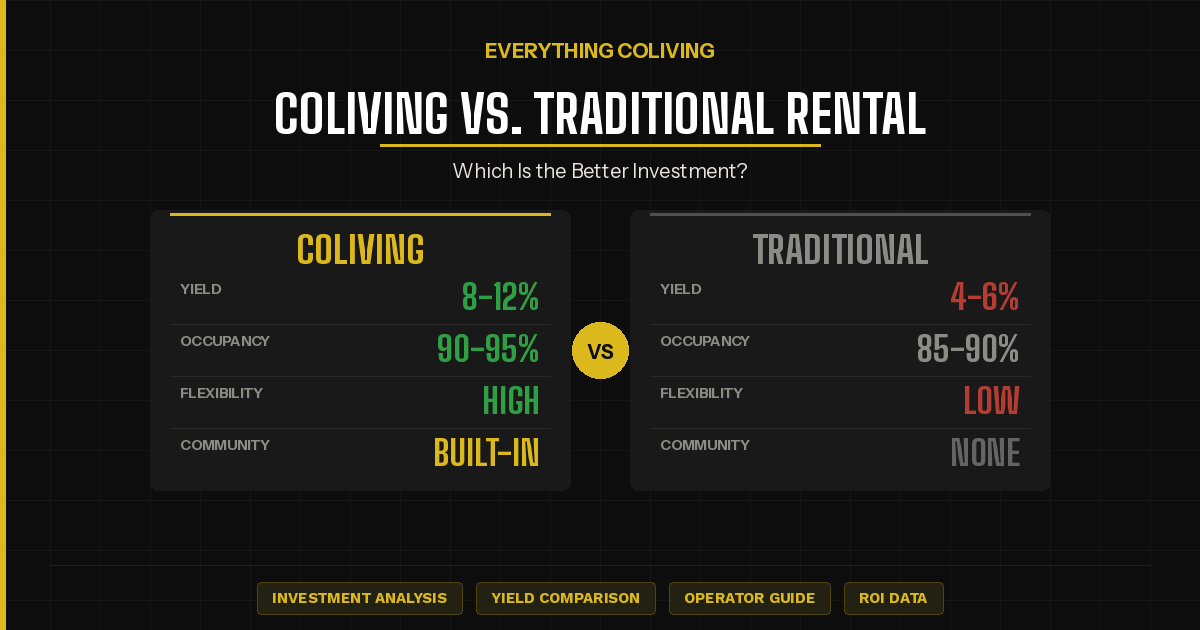
Traditional rentals typically achieve NOI margins of 55-70% of gross revenue. Coliving typically achieves 30-45% NOI margins, though on higher gross revenue. The result is that well-operated coliving often produces 15-30% higher NOI in absolute dollars from the same property.
Cash-on-Cash Returns
Traditional rentals in major markets typically deliver 4-8% cash-on-cash returns. Coliving properties, given higher revenue, typically deliver 8-15% cash-on-cash returns. However, coliving requires higher initial capital investment for furnishing and setup.
Risk Comparison
Traditional Rental Risks
- Tenant default (mitigated by security deposits and screening)
- Extended vacancy
- Major maintenance issues
- Market rent declines
- Regulatory changes (rent control, eviction restrictions)
Coliving Risks
All of the above, plus:
- Higher resident turnover
- Community management challenges
- Regulatory uncertainty (coliving-specific regulations are still evolving)
- Operational complexity
- Brand and reputation risk
- Furnishing depreciation
Risk Mitigation
Coliving's per-bed model actually reduces some risks. If one resident leaves, you lose 20-25% of the unit's revenue rather than 100%. Diversified income across multiple residents provides more stable cash flow.
Operational Demands
Traditional Rental: Passive
Find a tenant, collect rent, handle occasional maintenance. Can be almost entirely hands-off with a property manager.
Coliving: Active
Resident screening, community management, event programming, maintenance coordination, cleaning schedules, technology management, and marketing. Coliving is a hospitality business, not a passive investment.
The Hybrid Approach
Some investors hire coliving operators to manage their properties through management contracts. The investor provides the real estate, the operator provides the expertise. Typical management fees are 15-25% of revenue.
Who Should Choose What?
Traditional Rental Is Better If:
- You want passive income with minimal involvement
- You have limited capital for initial setup
- You prefer stable, predictable cash flows
- You are investing in markets with rent control
- You do not want to learn a new business model
Coliving Is Better If:
- You want to maximize revenue per square foot
- You enjoy hospitality and community building
- You have the capital for furnishing and technology
- You are investing in markets with strong young professional demand
- You are willing to invest time in operations or hire skilled managers
The Verdict
Coliving is not "better" than traditional renting. It is a different business. Traditional renting is a real estate investment. Coliving is a real estate-enabled hospitality business. The returns are higher, but so are the demands. The most successful coliving investors understand this distinction and choose their model accordingly.
For investors who want the best of both worlds, starting with a single coliving property while maintaining a traditional portfolio provides diversification and a learning opportunity without overcommitting to an unfamiliar model.
You Might Also Like

Coliving Financial Model: Understanding Unit Economics
Break down the unit economics of a coliving business. Revenue per bed, cost structure, break-even analysis, and how to model profitability at different scales.
January 4, 2026

Coliving Lease Agreements: What to Include and What to Avoid
Your lease agreement sets the legal foundation for your coliving business. Learn the essential clauses, common pitfalls, and best practices for coliving-specific leases.
January 10, 2026

Coliving Insurance: A Comprehensive Guide for Operators
Coliving properties face unique insurance challenges. Learn about the policies you need, common coverage gaps, and how to protect your business.
January 31, 2026