
Coliving Lease Agreements: What to Include and What to Avoid

Recommended Tools
Free interactive tools related to this article.
ROI Calculator
Estimate potential returns and payback periods for coliving.
Try it free →Operating Budget Template
Build a comprehensive operating budget for your property.
Try it free →Pricing Optimizer
Find the optimal pricing strategy for your coliving rooms.
Try it free →Vacancy Cost Calculator
Quantify the true cost of empty rooms in your property.
Try it free →Why Standard Leases Do Not Work for Coliving
Traditional residential leases were designed for a simple relationship: one tenant, one unit, fixed term. Coliving introduces complexities that standard leases do not address: shared spaces, community rules, flexible terms, all-inclusive pricing, and the community-oriented nature of the living arrangement.
Using a standard residential lease for coliving is like using a bicycle helmet for motorcycle riding - it provides some protection, but not nearly enough for the actual risks involved.
Essential Clauses for Coliving Leases
1. Space Definition
Clearly define what the resident is renting and what is shared:
- Private space: Specific room number, approximate dimensions, included furnishings
- Shared spaces: List all common areas the resident has access to (kitchen, living room, coworking, laundry, outdoor areas)
- Storage: Assigned storage space (fridge shelf, pantry cabinet, closet)
- Amenities: WiFi, cleaning service frequency, included utilities
Why It Matters: Ambiguity about shared space access and amenities is the most common source of resident complaints and disputes.
2. All-Inclusive Pricing Structure
Detail exactly what is included in the monthly rate:
- Base rent for private room
- Utilities (electricity, water, gas, heating/cooling)
- Internet/WiFi
- Regular cleaning (specify frequency: common areas and private rooms)
- Community events and programming
- Furnishings and their maintenance
- Any fair usage limits (e.g., utilities capped at reasonable personal use)
Important: Include a clause allowing rate adjustments for extraordinary utility usage. Without this, one resident mining cryptocurrency or running space heaters 24/7 can destroy your margins.
3. Term and Flexibility
Coliving thrives on flexibility, but operators need some predictability:
- Minimum term: Typically 1-3 months
- Notice period: 30 days for month-to-month; longer for discounted long-term rates
- Early termination: Define any penalties or forfeited deposits
- Renewal: Automatic month-to-month renewal after initial term
- Rate changes: How much notice is required for rate increases (typically 30-60 days)
4. Community Standards and House Rules
Incorporate your house rules by reference:
- Reference the house rules document as an addendum to the lease
- State that violation of house rules constitutes a lease violation
- Reserve the right to update house rules with reasonable notice (typically 14-30 days)
- Include the enforcement and escalation framework
5. Guest Policy
Be specific about guest rights and limitations:
- Maximum number of guest nights per month (typically 3-5)
- Advance notice requirements
- Guest registration requirements (for security)
- Liability for guest behavior and damages
- Prohibition on unauthorized subletting or room sharing
6. Furnishing and Property Condition
- Inventory list of all furnishings provided in the room
- Condition assessment at move-in (with photos)
- Resident responsibility for damage beyond normal wear and tear
- Operator responsibility for maintenance and replacement of provided items
- Prohibition on removing or modifying furnishings without permission
7. Community Participation
While you cannot force community participation, you can set expectations:
- Attendance at mandatory safety orientations
- Participation in community decision-making processes (optional but encouraged)
- Responsibility to maintain common area cleanliness
- Obligation to report maintenance issues and safety concerns
8. Termination Clauses
Operator-Initiated Termination:
- Material breach of lease terms (non-payment, serious rule violations)
- Notice period required (follow local law, typically 30-90 days)
- Documented warnings before termination (except for serious violations)
- Refund policy for prepaid rent
Resident-Initiated Termination:
- Notice period requirements
- Early termination fees (if applicable)
- Move-out procedures and timeline
- Security deposit return process and timeline
9. Data and Privacy
- What personal data you collect and how it is used
- Smart lock access data retention policy
- Security camera disclosure (locations and purpose)
- Communication channel monitoring policy (if any)
- Compliance with local data protection laws (GDPR in Europe)
10. Dispute Resolution
- Internal resolution process (community manager mediation)
- External mediation before legal action
- Jurisdiction and governing law
- Small claims court threshold
Common Legal Pitfalls
1. Misclassifying the Relationship
In some jurisdictions, coliving residents may be classified as tenants, lodgers, or licensees - each with different legal protections. Understand your local classification and ensure your lease aligns with it.
2. Discriminatory Screening
While curating community fit is important, resident screening must comply with fair housing laws. You cannot discriminate based on race, religion, gender, disability, family status, or other protected characteristics. "Community fit" criteria must be objective and consistently applied.
3. Security Deposit Violations
Many jurisdictions have strict rules about security deposit amounts, handling (separate accounts), and return timelines. Non-compliance can result in penalties of 2-3x the deposit amount.
4. Inadequate Notice Periods
Termination notice periods are often regulated by local law and may be longer than what your lease specifies. Always check local requirements - your lease cannot override statutory minimums.
5. Unenforceable Clauses
Clauses that waive tenant rights, impose excessive penalties, or violate consumer protection laws are unenforceable and can invalidate other parts of your lease.
Lease vs License Agreement
Some coliving operators use license agreements instead of leases:
License Agreement grants permission to use a space without creating a tenancy. Benefits:
- Often provides more flexibility for the operator
- May avoid some tenant protection regulations
- Easier to terminate
Lease Agreement creates a formal tenancy with associated tenant rights. Benefits:
- Clearer legal framework
- Residents may feel more secure
- More established legal precedent
Recommendation: Consult with a local real estate attorney to determine which structure is appropriate in your jurisdiction. The wrong choice can expose you to significant legal risk.
Best Practices
- Always use a lawyer: Have your lease reviewed by an attorney familiar with local landlord-tenant law and ideally with coliving or hospitality experience
- Keep it readable: Write in plain language. A lease that residents cannot understand is a lease that will cause problems
- Update regularly: Review and update your lease annually to reflect regulatory changes and lessons learned
- Be consistent: Apply the same lease terms to all residents. Inconsistent enforcement undermines your legal position
- Document everything: Move-in condition reports, communications about issues, warnings - all documented and filed
- Provide copies: Give every resident a signed copy of their lease and all addenda
- Separate house rules: Keep house rules as a separate, referenced document that can be updated more easily than the lease itself
Your lease agreement is the legal foundation of your coliving business. Invest the time and money to get it right. A well-crafted lease prevents disputes, protects your business, and gives residents confidence in the professionalism of your operation.
Download our Coliving Lease Template as a starting point, then customize with your attorney for your specific jurisdiction and business model.
You Might Also Like

Coliving Pricing Strategies: How to Maximize Revenue Per Bed
Learn dynamic pricing, tiered room strategies, and ancillary revenue tactics that top coliving operators use to maximize their revenue per bed.
January 16, 2026

Coliving Resident Screening: Best Practices for Community Fit
Screening for coliving is different from traditional rentals. Learn how to evaluate both financial reliability and community compatibility.
January 22, 2026
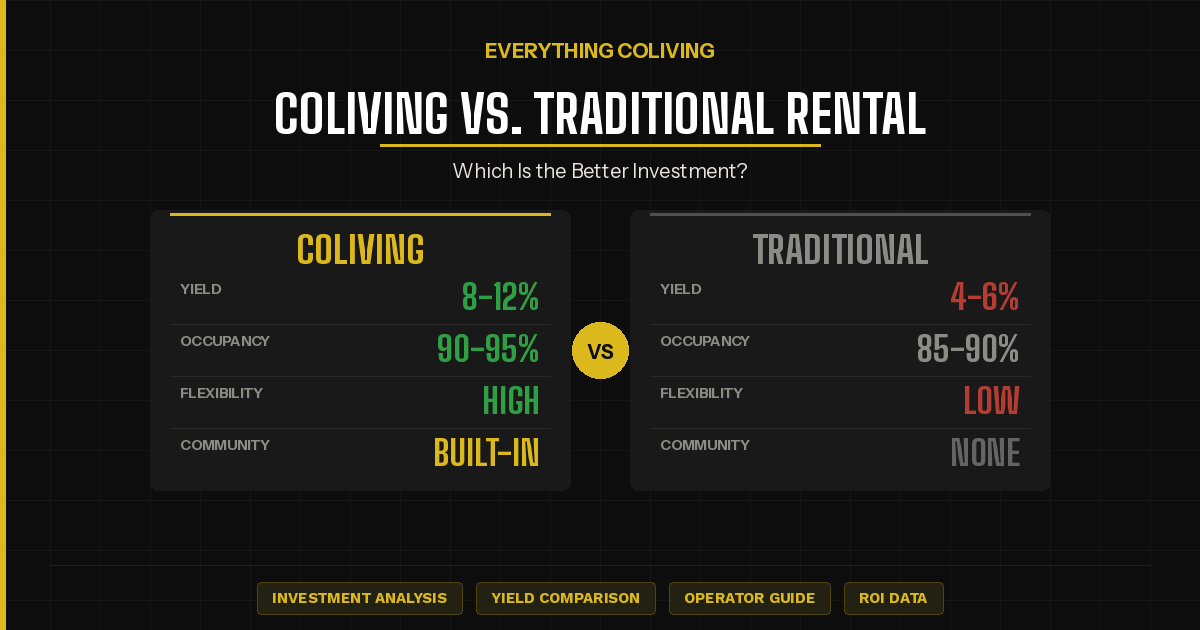
Coliving vs. Traditional Rental: Which Is the Better Investment?
Compare the financial returns, risks, and operational demands of coliving investments against traditional buy-to-let properties.
March 8, 2026