Coliving Marketing Launch Plan: First 90 Days
Recommended Tools
Free interactive tools related to this article.
The Marketing Challenge for New Coliving Spaces
You have signed the lease, furnished the property, set up the technology, and hired your community manager. Now comes the hardest part: getting people through the door. The first 90 days of marketing determine how quickly you reach cash-flow break-even, every empty room is burning money against your runway.
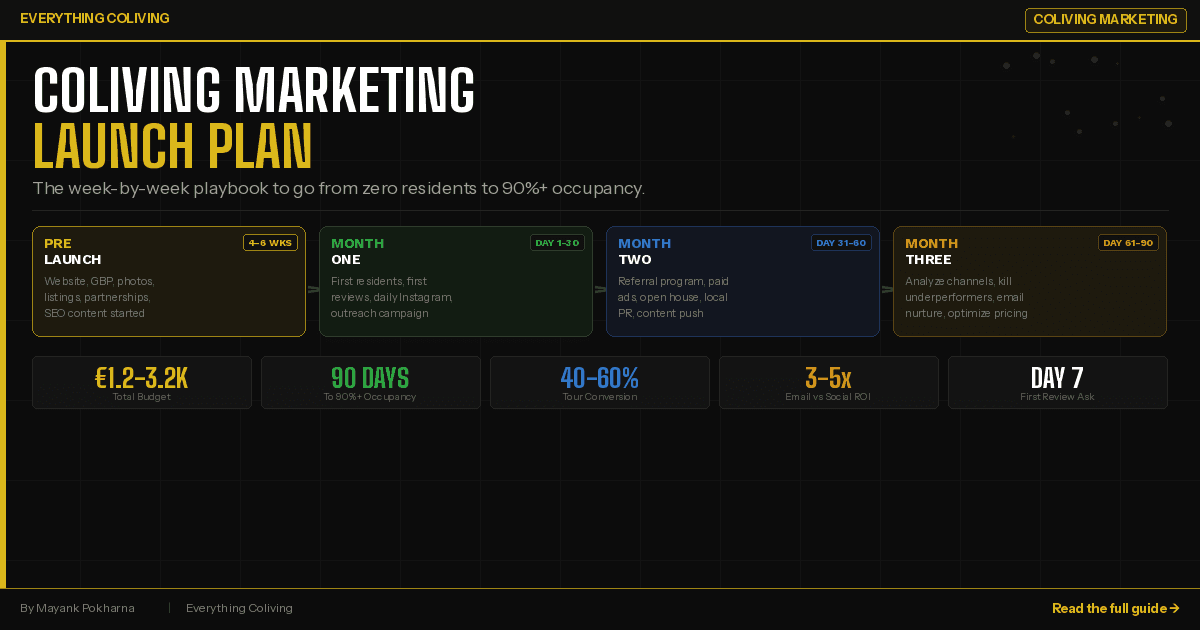
This launch plan provides a week-by-week playbook with specific actions, channel strategies, and budget allocation. It is designed for a single-property launch with a total marketing budget of €1,500-€3,000, though individual tactics can be scaled up or down based on your resources.
Pre-Launch Phase (4-6 Weeks Before Opening)
Week 1-2: Foundation
- Website live: Even a simple one-page site with: property photos, room types and pricing, location, key amenities, and a booking inquiry form. Use a simple builder (Carrd, Squarespace, WordPress). Budget: €0-€500.
- Google Business Profile: Claim and fully complete your GBP listing. Add all photos, description, categories, attributes, and services. This starts your local SEO clock.
- Social media accounts: Create Instagram and optionally TikTok. Post your first 5-10 pieces of content: property progress, neighbourhood highlights, behind-the-scenes setup. Start building an audience before launch.
- Domain email: Set up a professional email (hello@yourcoliving.com) for inquiries.
Week 3-4: Content Creation
- Professional photography: Hire a photographer or do a thorough DIY shoot. Capture: every room type, all common areas, exterior, neighbourhood, and lifestyle shots if possible. Budget: €300-€800.
- Listing copy: Write compelling descriptions for your website, Airbnb, and other platforms. Focus on your unique selling points and target resident persona.
- SEO content: Publish 2-3 blog posts targeting "coliving [your city]" and related searches. These take weeks to rank but start the process early.
Week 5-6: Launch Preparation
- Airbnb and OTA listings: Publish listings on Airbnb (with monthly discount), Booking.com (if applicable), HousingAnywhere, NomadX, and local platforms.
- Partnerships activated: Contact 10+ local coworking spaces, language schools, relocation services, and digital nomad communities. Offer a referral incentive or cross-promotion.
- Soft launch outreach: Email your personal and professional network announcing the opening. Ask for shares and referrals. Often your first residents come from your network.
- Google Business Profile: Seed 5-10 Q&A entries on your GBP.
Month 1: Foundation Building (Opening Day Through Day 30)
Primary Focus: Get First Residents and First Reviews
- Opening promotion: Offer 15-20% off the first month for your first 5 residents who commit to 2+ month stays. This accelerates occupancy while building community critical mass.
- SEO content: Publish 4 blog posts this month. Mix of: neighbourhood guide, "why coliving in [city]," practical tips for moving to your city, and a comparison piece (coliving vs Airbnb vs apartment).
- Instagram calendar: Post daily, alternate between: property photos, neighbourhood content, city tips, behind-the-scenes, and community moments (even if community is small, first residents cooking together counts).
- Outreach campaign: DM 10 relevant accounts per day on Instagram (travel bloggers, remote work accounts, nomad communities). Not hard selling, genuine engagement and information sharing.
- First reviews: Ask your first residents for a Google review at day 7 (once settled and happy). Your first 5 reviews have outsized impact on GBP visibility.
- Community events: Host a weekly open dinner (invite residents AND local remote workers) and one neighbourhood event (walking tour, cafe crawl). These generate content and attract potential residents.
Budget allocation Month 1: Photography (if not done pre-launch) €300-€500, Airbnb promotion €100-€200, Instagram/Facebook ads €100-€200. Total: €500-€900.
Month 2: Amplification (Day 31-60)
Primary Focus: Expand Reach and Build Social Proof
- Referral program launch: Implement a formal referral program, €100-€150 credit for referrers, 10% off first month for referred residents. Announce to all current residents and alumni.
- Paid advertising (€300-€500 budget): Run targeted ads on Instagram and Facebook. Target: remote workers, digital nomads, and expats interested in your city. Use your best lifestyle photos and a clear CTA (Book a tour/Check availability). Test 3-4 ad creatives and double down on what converts.
- Open house event: Host a monthly open house, invite prospective residents, local coworkers, and the community. Property tour, drinks, community showcase. The conversion rate from in-person visits is 40-60%. Promote via GBP post, Instagram, local event platforms, and partner organizations.
- Local PR: Pitch your story to local media, expat publications, and remote work blogs. "New coliving opens in [neighbourhood]" is a natural news story. Create a simple press release and send to 15-20 relevant publications.
- Content acceleration: Publish 4+ blog posts. Add resident stories (with permission), "Meet [Name]: Why a [Profession] from [Country] Chose Coliving in [City]." These are highly shareable and build trust.
- Review generation: Target 3-5 new Google reviews this month. Ask happy residents after positive interactions.
Budget allocation Month 2: Paid ads €300-€500, Open house costs €100-€200, PR materials €0-€100. Total: €400-€800.
Free Newsletter
Join 36,000+ coliving professionals
Weekly insights on operations, marketing, and growth, delivered to your inbox.
Subscribe Free →Month 3: Optimization (Day 61-90)
Primary Focus: Analyze, Double Down, and Kill Underperformers
- Analyze all channels: Which channels generated the most inquiries? Which had the highest conversion to bookings? Which had the lowest cost per acquisition? Build a simple channel attribution spreadsheet.
- Double down on winners: If Instagram drives inquiries, increase posting frequency and ad spend. If partnerships generate bookings, deepen those relationships. If SEO is starting to show traffic, produce more content.
- Kill underperformers: If a channel generated zero inquiries in 60 days (after genuine effort), reallocate that budget and time. Not every channel works in every market.
- Email nurture: By now you should have 50-200 emails from inquiries, event attendees, and website visitors. Launch a monthly email newsletter: community updates, city tips, availability, and a booking CTA. Email converts at 3-5x the rate of social media.
- Pricing optimization: Based on 2 months of data, adjust pricing. If demand is strong, increase rates on your best rooms. If certain rooms are slow, offer limited promotions or adjust positioning.
- 90-day review: Document everything you have learned. What was your cost per booking? Which rooms filled fastest? What feedback did residents give about how they found you? This data informs your ongoing strategy.
Budget allocation Month 3: Paid ads €200-€400 (optimized spend), Email tool €0-€50, Content/design €100-€200. Total: €300-€650.
Total 90-Day Budget Summary
| Category | Budget Range |
|---|---|
| Photography | €300-€800 |
| Website | €0-€500 |
| Paid advertising | €500-€1,000 |
| Events (open house, community) | €200-€400 |
| Content and design | €100-€300 |
| Email tool | €0-€50 |
| Miscellaneous | €100-€200 |
| Total | €1,200-€3,250 |
This budget assumes you are doing most of the work yourself or with your CM. If outsourcing content creation, social media management, or SEO, add €500-€1,500 per month. For a full marketing assessment, use our marketing audit tool. For ongoing strategy guidance, see our marketing strategies guide.
Key Metrics to Track from Day 1
- Inquiries per week (and source)
- Inquiry-to-tour conversion (target: 30-40%)
- Tour-to-booking conversion (target: 40-60%)
- Cost per inquiry (by channel)
- Cost per booking (by channel)
- Website visitors (and top landing pages)
- Google Business Profile views and actions
- Social media followers and engagement rate
- Review count and average rating
Frequently Asked Questions
What is the most important marketing channel for a new coliving?
For the first 3 months, Airbnb and OTA listings typically drive the most bookings because they provide immediate access to an audience actively searching for accommodation. Simultaneously, invest in Google Business Profile and SEO, these become your dominant channels by month 6-12 but need time to build. Do not skip OTAs in the launch phase just because commissions are high.
How quickly should a new coliving reach full occupancy?
A realistic ramp-up for a well-marketed coliving: 30-40% occupancy by end of month 1, 60-70% by month 2, 80-85% by month 3, and 90%+ by month 4-6. If you are not reaching 50% by month 2, there is likely a pricing, positioning, or visibility issue that needs urgent attention. Speed of ramp-up is heavily market-dependent, established coliving cities ramp faster than pioneer markets.
Should I offer discounts to fill rooms quickly?
Yes, selectively. Launch discounts (15-20% off the first month for early residents who commit to 2+ months) are standard and effective. They create urgency, build community critical mass, and generate reviews. However, avoid deep ongoing discounts, they train the market to expect lower prices and are difficult to reverse. Time-limit all discounts and be transparent about the regular pricing residents will pay after the promotional period.
How important is social media for coliving marketing?
Instagram is the second most important channel after Google (GBP + SEO) for most coliving operations. It builds brand awareness, showcases the lifestyle experience, and drives website visits. However, social media rarely converts to direct bookings on its own, it works best as part of a funnel: Instagram builds awareness, the website converts interest, and your booking process closes the deal. Invest time in social media but track its actual contribution to bookings, not just follower counts.
Written by
Admin
Admin is a contributor at Everything Coliving, the leading growth platform for coliving operators worldwide. Everything Coliving has been featured in 50+ publications including Forbes India, BBC Punjabi, and Financial Express.
Explore Related Topics
Further Reading
Related Articles

Membership Agreement vs Lease Agreement in Coliving
Comparison of membership vs lease agreements covering: Flexibility for Tenants (shorter commitment, easy move-in/out), Simplified Eviction Process (easier termination, reduced squatter risk), Access t...

How to Get Your First 100 Customers for Your Coliving Space: A Comprehensive Guide
Comprehensive guide covering: understanding target audiences through demographics and psychographics, building online presence via professional websites and SEO, utilizing platforms like Coliving.com...

The ultimate marketing stack for your coliving business
Extensive guide covering five sections: Building Online Presence with Website Tools (Strikingly, Wix, WordPress, Webflow, Framer), Harnessing SEO Power (Moz, SEMrush, Ahrefs), Content Marketing (Super...