
Coliving Marketing
Coliving Marketing Launch Plan: First 90 Days
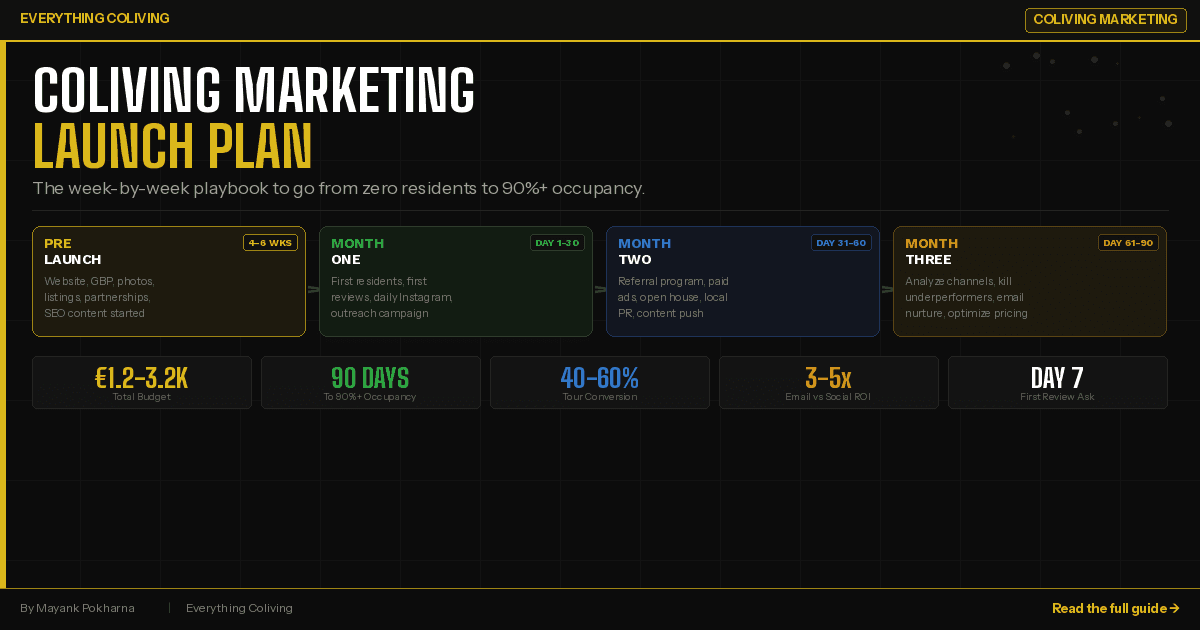
A week-by-week marketing launch plan for new coliving spaces, covering pre-launch, months 1-3, channel strategy, and a budget of €1,500-€3,000 total.
March 22, 2026
Monthly masterminds, weekly updates, and networking with coliving operators worldwide.

From SEO and paid ads to community-driven referrals and partnership marketing - every channel, tactic, and metric you need to fill your coliving spaces, build a recognizable brand, and achieve 90%+ occupancy.
Last updated: April 2026 | Based on data from 60+ operators across 14+ countries
“SEO drives 40-60% of long-term coliving lead generation for established operators” — Everything Coliving Marketing Benchmarks 2025
“Average cost per lead via Google Ads for coliving: $12-25” — EC Industry Data, 60+ operators
“Direct bookings yield 15-20% more revenue than OTA channels” — Hospitality Net Coliving Report 2025
Data sources: JLL Research, Savills Living Sectors, CBRE Flexible Living, Cushman & Wakefield Alternative Living, Everything Coliving 2026 Industry Research (500+ operator surveys).
Interactive calculators and tools to put these insights into action.
Score your marketing strategy and get recommendations.
Try it free →Identify resident personas, recommend pricing per segment, and find underserved opportunities.
Try it free →Find the optimal pricing strategy for your coliving rooms.
Try it free →Analyze competitors with positioning maps and gap analysis.
Try it free →Email Marketing ROI
Avg Real Estate CAC
Higher Retention via Referrals
Gain Customers via Blogging
The coliving industry has moved past the "if you build it, they will come" phase. With the global market projected to reach $13.9 billion by 2030 and new operators launching weekly, having an exceptional space is no longer enough - you need a systematic marketing engine to fill it.
The Art of Coliving framework identifies marketing as one of the 12 essential pillars of a successful coliving operation. Yet most operators treat marketing as an afterthought - spending 80% of their energy on design and operations, then wondering why beds remain empty.
The data is clear: operators who invest strategically in marketing achieve 15-25% lower vacancy rates, reduce customer acquisition costs by up to 60%, and build brands that command premium pricing. Community-driven marketing - where your residents become your greatest advocates - is the coliving industry's unique competitive advantage over traditional real estate.
This guide covers every marketing channel, from digital marketing and SEO to PR and media, with specific benchmarks, tactics, and KPIs for coliving operators at every stage.
Each channel serves a different purpose in your marketing funnel. Top operators use 4-6 channels simultaneously to maintain 90%+ occupancy.
Organic search captures high-intent leads searching for 'coliving in [city]'. 57% of B2C companies report gaining customers through blog content. Coliving SEO targets long-tail keywords with strong local intent.
Key Tactics
Best for: Long-term sustainable growth with compounding returns
Pay-per-click advertising captures immediate demand. Average real estate CAC is $791, but targeted coliving campaigns achieve significantly lower costs by focusing on high-intent long-tail keywords and remarketing.
Key Tactics
Best for: Filling vacancies quickly and testing new markets
Social advertising excels at awareness and consideration stages. Lookalike audiences built from existing residents drive efficient acquisition. Video tours and community content generate 3-5× higher engagement than static ads.
Key Tactics
Best for: Brand awareness, community storytelling, and lead generation
Referred customers have a 37% higher retention rate and 16% higher lifetime value. Community-driven referrals are the most cost-effective acquisition channel. Top operators report 25-40% of new residents coming through referrals.
Key Tactics
Best for: Mature communities with strong resident satisfaction
Platforms like Coliving.com, NomadList, Anyplace, and HousingAnywhere aggregate demand from digital nomads and remote workers actively searching for coliving. Essential for international visibility.
Key Tactics
Best for: Reaching international and digital nomad audiences
Email marketing delivers a 42:1 ROI - $42 for every $1 spent. Automated nurture sequences convert leads who aren't ready to book immediately. Segmentation by persona (nomad, young professional, student) boosts open rates by 26%.
Key Tactics
Best for: Nurturing leads and maintaining alumni relationships
Need help building a multi-channel marketing strategy? Our growth marketing team has helped 60+ coliving operators across 14+ countries achieve measurable results.
From SEO and paid ads to brand strategy - our team builds marketing engines that deliver predictable growth.
57% of companies gain customers through blogging. For coliving, content marketing is especially powerful because the product - community and lifestyle - is inherently story-rich and shareable.
Resident testimonials, day-in-the-life content, community event recaps. This is your most powerful content type - 92% of consumers trust peer recommendations over advertising.
Formats: Video interviews, photo essays, social media takeovers
Frequency: 2-3× per week on social media
Neighborhood guides, best cafes for remote work, cultural events, transportation tips. Positions your space as a gateway to the local experience.
Formats: Blog posts, Instagram guides, TikTok location tours
Frequency: 1-2× per week
What is coliving, how to choose a coliving space, coliving vs traditional renting. Captures top-of-funnel search traffic from people discovering coliving.
Formats: Blog articles, YouTube explainers, infographics
Frequency: 1-2× per month
Property renovation updates, team introductions, operator journey stories. Humanizes your brand and builds trust with potential residents.
Formats: Instagram Stories, TikTok, LinkedIn posts
Frequency: 2-3× per week
Explore our coliving marketing blog for in-depth content strategy guides and case studies.
Be where your potential residents are searching. Multi-platform presence is essential - 78% of prospects book with the first space that responds.
| Platform | Audience | Reach | Cost | Strength |
|---|---|---|---|---|
| Coliving.com | Global coliving seekers | 500K+ monthly visitors | Listing fee / commission model | Largest dedicated coliving marketplace |
| NomadList | Digital nomads & remote workers | 1M+ registered nomads | Free listing with premium options | Highly targeted nomad audience with city ratings |
| Anyplace | Remote professionals | Growing platform | Commission on bookings | Focus on furnished, flexible-term housing |
| HousingAnywhere | International students & professionals | 3M+ annually | Service fee model | Strong in European markets and university cities |
| Facebook Groups | City-specific housing seekers | Varies by market | Free | Direct community engagement, high trust factor |
| Google Business Profile | Local searchers | Dominant local search | Free | Appears in Maps and local pack - 46% of searches have local intent |
Need help optimizing your listing presence? Our digital marketing team manages listing profiles, SEO, and paid advertising for coliving operators worldwide.
Coliving's unique advantage: your product - community - is its own best marketing. Residents who feel connected become advocates. This is the lowest-cost, highest-converting marketing strategy in coliving.
Monthly open-house events where anyone can visit, meet residents, and experience the community. The most effective low-cost lead generation tactic - converts at 30-50% when paired with a special offer.
How to implement: Host themed events (coworking day, community dinner, workshop) open to the public. Require registration to capture leads.
Recruit current residents as brand ambassadors. They share their experience on social media, bring friends to events, and receive perks in return. Authentic advocacy outperforms any paid campaign.
How to implement: Select 3-5 socially active residents. Provide content guidelines, branded hashtags, and monthly rewards (rent discounts, event credits).
Former residents are your best marketing asset. They recommend your space to others, return for future stays, and become evangelists in their networks. 60% of coliving residents say they'd return.
How to implement: Create a private alumni community (Slack/WhatsApp), offer return-resident discounts, send quarterly updates, and incentivize referrals.
Partner with local businesses, host neighborhood events, and become a recognized community hub. This generates organic word-of-mouth and positions your space as a neighborhood asset - not just housing.
How to implement: Host public workshops, partner with local cafes and fitness studios, sponsor local events, and join neighborhood associations.
Building a thriving community is the foundation of effective marketing. Learn more in our Resident & Community Experience guide.
Strategic partnerships provide predictable occupancy, premium pricing, and access to new audiences. A single corporate partnership can fill 5-15 beds consistently.
Companies increasingly use coliving for team retreats, project-based housing, and relocation. Contracts are typically 3-12 months with guaranteed occupancy. Corporate clients pay 20-40% premium over individual rates.
Approach: Target remote-first companies, HR teams, and relocation agencies. Offer packages with workspace, team-building activities, and flexible terms.
Universities with housing shortages, exchange programs, and summer programs need flexible accommodation. Semester-length stays provide predictable occupancy during academic months.
Approach: Partner with international student offices, study-abroad programs, and graduate housing departments. Offer student-specific rates and community programming.
Co-marketing with coworking spaces creates a complete live-work ecosystem. Cross-referrals benefit both parties - coworking members need housing, coliving residents need workspace.
Approach: Negotiate member discount programs, co-host events, and create bundled live-work packages. Joint marketing campaigns targeting remote workers.
Local tour operators, cooking classes, surf schools, and cultural experiences enrich the coliving offering. Revenue-share partnerships create additional value without cost.
Approach: Curate a resident experience marketplace. Offer exclusive resident pricing on local experiences. Feature partners in your content marketing.
For operators exploring business model options, our business models guide covers the financial frameworks behind successful partnerships.
Our newsletter reaches 36,000+ subscribers and our podcast has 100+ episodes featuring top coliving operators.
Driving traffic means nothing if visitors don't convert. These five optimizations can increase your inquiry-to-move-in rate by 45% or more.
53% of mobile visitors leave if a page takes more than 3 seconds to load. Mobile-first design is non-negotiable - over 65% of coliving inquiries come from mobile devices.
Display resident testimonials, Google reviews (aim for 4.5+ stars), and occupancy indicators ('Only 2 rooms left'). 88% of consumers trust online reviews as much as personal recommendations.
Properties with virtual tours receive 87% more views. Interactive 360° tours let prospects explore at their own pace. Video tours on landing pages increase conversion by 80%.
Reduce form fields to essentials (name, email, dates, budget). Every additional field reduces conversion by 11%. Offer instant booking or 'schedule a tour' as primary CTAs.
78% of prospects book with the first space that responds. Install live chat (or WhatsApp Business) and aim to respond within 5 minutes during business hours.
Need a high-converting coliving website? Our website development team builds conversion-optimized platforms for coliving operators.
Data-driven operators outperform those who rely on gut instinct. Track these metrics monthly to optimize your marketing spend and maximize occupancy.
92-97%
The north star metric. Measures beds occupied vs available.
Occupied Beds ÷ Total Available Beds × 100
$50-$200
Total marketing + sales spend divided by new residents acquired. Industry average is $791 for real estate, but coliving can be much lower.
Total Marketing Spend ÷ New Residents Acquired
< 2 months
Time to recover acquisition cost from resident revenue. Should be under 60 days for healthy unit economics.
CAC ÷ Monthly Gross Margin per Resident
25-40%
Percentage of inquiries that result in a property tour (virtual or in-person). Speed of response is the biggest driver - 78% book with the first responder.
Tours Completed ÷ Inquiries Received × 100
40-60%
Percentage of tours that result in a signed lease. High conversion indicates strong product-market fit and effective tour experience.
Move-ins ÷ Tours Completed × 100
6-12 months
Longer stays reduce turnover costs and improve community stability. Marketing should target residents likely to stay 6+ months.
Sum of All Stay Durations ÷ Number of Residents
25-40%
Percentage of new residents who came through referrals. High referral rates indicate strong community satisfaction and reduce CAC.
Referred Move-ins ÷ Total Move-ins × 100
$10-$40
Cost to generate a qualified inquiry. Tracks efficiency across paid channels. Organic channels (SEO, referrals) should drive CPL down over time.
Channel Spend ÷ Leads Generated from Channel
Our Global Coliving Report provides market data, operational benchmarks, and growth trends from 200+ operators across 40+ countries.
Learn from the patterns we've seen across 60+ coliving operators worldwide. These are the most common pitfalls that derail otherwise promising ventures.
Operators with €5K/month budgets routinely run Google, Meta, TikTok, and SEO simultaneously, none at enough depth to work. Concentrate 70% of spend in the single channel where your ICP actually researches; diversify only once you've found product-market fit on channel one.
If your blended CAC sits above 1 month of gross rent for a 6-month average stay, you're burning cash to scale. Track CAC by channel weekly and cap each channel at 3x ROI, otherwise, media spend quietly eats margin.
Logos, color palettes, and Instagram aesthetics matter less than a crisp answer to "who is this for and why is it different." Operators who invest six figures in brand before nailing positioning consistently underperform those who do the opposite.
Third-party listings like Nestpick, HousingAnywhere, and Uniplaces can drive bookings but charge 12-25% commission and prevent you from building a first-party audience. Use them to seed early occupancy, then aggressively shift toward direct demand.
Stock photos and agency-rendered interiors kill trust at the research stage, residents can smell them. Invest in professional photography of your actual property, real residents (with consent), and unretouched common areas to drive conversion.
Coliving research cycles average 4-8 weeks for medium-term stays. Operators who don't retarget site visitors and capture emails for a 6-week nurture sequence leave 30-40% of pipeline on the table.
Anonymized examples from our advisory work with coliving operators across 14+ countries.
European metropolitan operator
Shifted from a 60/40 listing-to-direct mix to 15/85 by investing in SEO, a dedicated booking flow, and a 6-week email nurture sequence. Blended CAC dropped from €420 to €180 per booking within 9 months, and LTV climbed 22% as direct-channel residents stayed longer.
Sunbelt US portfolio
Ran a single-channel Meta-only strategy for 90 days with lookalike audiences built off existing residents. Hit a 3.8x ROAS and filled two new property openings without listings; only then expanded to Google search for bottom-funnel branded and non-branded keywords.
Southeast Asian operator
Invested in user-generated content from residents, short-form video, honest reviews, day-in-the-life content, and let it run as organic TikTok and Reels. Generated 2.3M cumulative views across 4 months and 18% of new bookings in the subsequent quarter came directly from that content.
Actionable insights from 11+ years of coliving advisory work.
Start with exactly one channel and run it hard for 90 days before adding a second. Most operators with under €10K/month in media spend should pick between SEO, Meta, or one major listing platform, not spread across all three. Depth beats breadth at early stages.
Track CAC separately for every channel and review weekly. Healthy coliving CAC sits at roughly 50-80% of one month's rent for medium-term stays; anything above 100% is a signal to either cut spend or improve conversion before scaling.
Build positioning before brand. Nail down "who this property is for, what they're choosing against, and why we win" in one paragraph, then invest in brand identity. Operators who invert this order consistently burn six figures on design that doesn't convert.
Invest in professional photography at launch, even on a tight budget. A €2-4K photoshoot will outperform €20K of agency-rendered CGI, because trust and authenticity are the primary conversion levers for medium-term coliving bookings. Real residents add the final 15% of credibility.
Build a retargeting and email nurture system on day one. Capture emails at every property page, retarget site visitors for 30-60 days on Meta, and run a weekly newsletter with community content. These three mechanics alone typically add 25-40% to booking volume.
Use listings strategically, not defensively. They're excellent for filling new-property ramp-up and capturing international demand, but keep commission under 12% of revenue long-term. Every month you over-rely on listings is a month your first-party audience doesn't grow.
Measure brand strength via direct-and-branded traffic share. When more than 40% of bookings come from direct URL plus branded search, your marketing is compounding. Below 15% means you're renting attention, not earning it, invest in content, community, and PR to close the gap.
Try these interactive tools to apply marketing strategy insights to your coliving business.
Score your marketing strategy and get prioritized recommendations.
Identify resident personas and recommend pricing per segment.
Find the optimal pricing strategy for your coliving rooms.
Analyze competitors with positioning maps and gap analysis.
No single channel dominates - the most effective coliving marketing strategy combines SEO for long-term organic traffic, referral programs for low-cost high-quality leads, and listing platforms for immediate visibility. Operators achieving 95%+ occupancy typically use 4-6 channels simultaneously. SEO and content marketing deliver the lowest CAC over time ($15-$50), while Google Ads provide immediate results for filling vacancies. The key is matching channels to your target persona - digital nomads respond to listing platforms and social media, while local young professionals find you through Google Search and community events.
Most successful coliving operators allocate 5-10% of gross revenue to marketing during growth phases, dropping to 3-5% once occupancy stabilizes above 90%. For a 50-bed space generating $30K/month, this means $1,500-$3,000/month in marketing spend. New properties should front-load marketing investment (up to 15% of projected revenue) during pre-launch and lease-up periods. The goal is to reduce marketing spend over time as referrals, SEO, and brand awareness generate organic demand.
Focus on three strategies: (1) Build a referral program - referred residents cost 70-90% less to acquire and stay 37% longer. (2) Invest in SEO and content marketing - organic traffic is free after the initial investment, and compounds over time. (3) Optimize conversion rate - improving your website's tour-to-move-in conversion from 30% to 50% effectively cuts your CAC by 40%. Also maintain presence on free listing platforms and leverage community events as low-cost lead generation.
At minimum: Coliving.com (largest dedicated marketplace with 500K+ monthly visitors), Google Business Profile (essential for local search - 46% of searches have local intent), and Facebook Groups (free, high-trust local communities). For operators targeting digital nomads, add NomadList and Anyplace. For European markets, HousingAnywhere is strong. For student housing, university housing boards. List on 5-8 platforms and maintain consistent, up-to-date profiles with professional photography on all of them.
Focus on Instagram and TikTok for consumer-facing content - property tours, community moments, day-in-the-life content, and city guides. Use LinkedIn for B2B relationships, corporate partnerships, and thought leadership. Post 4-5× per week on Instagram, 3-5× on TikTok, and 2-3× on LinkedIn. The key insight: authentic, user-generated content outperforms polished marketing. Let residents create content, run social media takeovers, and share real community moments. Video content (especially Reels and TikTok) gets 22% more engagement than static images.
Critical. 'Coliving in [city]' searches have grown 300%+ since 2019. Local SEO drives the highest-intent traffic - someone searching 'coliving in Lisbon' is actively looking for a space. Optimize your Google Business Profile, create city-specific landing pages, publish regular blog content, and build backlinks from coliving directories. Most coliving operators underinvest in SEO despite it having the lowest long-term CAC of any channel. Results take 3-6 months but compound over time - a well-ranked page generates leads for years.
Four content pillars: (1) Community stories - resident testimonials, event recaps, day-in-the-life content (your most powerful content type). (2) City and lifestyle guides - neighborhood guides, best remote-work cafes, cultural events. (3) Educational content - what is coliving, how to choose a space, coliving vs renting. (4) Behind-the-scenes - renovation updates, team introductions, operator journey. Video content drives the highest engagement. Aim for 2-3 social posts per week and 2-4 blog posts per month. Quality and consistency matter more than volume.
The best coliving referral programs use dual-sided rewards - both the referrer and the new resident receive benefits. Typical structures: $200-$500 rent credit for the referrer, one week free or reduced deposit for the referred. Top operators report 25-40% of new residents coming through referrals. Keys to success: make referral sharing easy (unique links or codes), celebrate referrals publicly, offer tiered bonuses for multiple referrals, and time outreach for when satisfaction is highest (after first community event or 30 days of residency).
Yes, but strategically. Paid ads are most valuable for: filling vacancies quickly, launching new properties, and testing new markets. Google Search ads capture high-intent demand ('coliving in [city]'), while Meta ads build awareness and retarget interested visitors. Start with a small budget ($500-$1,000/month), test different audiences and creatives, and scale what works. The key is tracking CAC per channel - if a channel's CAC exceeds 2 months' margin per resident, optimize or reallocate. Retargeting ads (showing your space to people who visited your website) typically deliver the best ROI.
The corporate retreat and housing market is $31.8B globally. Companies use coliving for team retreats, project-based housing, employee relocation, and remote work programs. Corporate contracts provide predictable occupancy (3-12 month terms), premium pricing (20-40% above individual rates), and lower acquisition costs. Target remote-first companies, HR departments, and relocation agencies. Offer packages with workspace, team-building activities, and flexible terms. A single corporate partnership can fill 5-15 beds consistently, making it one of the highest-ROI marketing activities.
Community-driven marketing turns your residents into your marketing team. It includes: open-house events (30-50% conversion rate), ambassador programs (residents share content for perks), alumni networks (60% of former residents would return), and local community integration (becoming a neighborhood hub). This approach works because coliving's core value proposition - community - is best demonstrated through real community experiences, not ads. The Art of Coliving framework emphasizes that authentic connection is the ultimate marketing tool.
Pre-launch marketing should start 3-6 months before opening. Phase 1 (6 months out): build website with SEO-optimized pages, set up Google Business Profile, create social media accounts, start documenting the build/renovation process. Phase 2 (3 months out): launch listing platform profiles, start paid advertising, begin email list building with a 'coming soon' landing page and early-bird pricing. Phase 3 (1 month out): host pre-launch events, activate referral network, ramp up social media, send press releases to local media. Target 30-50% pre-leased before opening day.
Deep dives into coliving marketing strategies, case studies, and growth tactics from operators worldwide.
A week-by-week marketing launch plan for new coliving spaces, covering pre-launch, months 1-3, channel strategy, and a budget of €1,500-€3,000 total.

A complete playbook for coliving operators to drive 70%+ direct bookings and reduce OTA dependency through SEO, GBP, social media, referrals, and email marketing.

Optimize your Airbnb listing to attract coliving residents, including title formulas, pricing strategy, Superhost tips, and when to transition bookings direct.

A step-by-step guide to setting up and optimizing your Google Business Profile for coliving, including review strategies and performance tracking.
Learn how to photograph your coliving space for maximum bookings, including equipment, lighting, composition, and editing tips that double inquiry rates.
Your brand is your biggest differentiator. Learn how to define your coliving identity, craft your messaging, and attract residents who fit your community.
Explore more in our Coliving Marketing blog category.
Essential reads
The marketing playbooks our operators use most. Pick the one matching your stage: launch, growth, or scaling.
Channel-by-channel launch playbook from operators who got to 100 paying residents.
The funnel + tech stack that gets operators off platform dependency.
Per-room pricing, dynamic adjustments, and the quarterly cadence that lifts RevPAB 8-15%.
When manual quarterly repricing leaves money on the table and how to fix it.
Brand archetypes, positioning, and the operational consequences of getting it wrong.
Where AI agents actually move occupancy needles vs. where they don't.
When operators applying this pillar ask us where to actually list their spaces, our answer is BookMyColiving, the EC team's free coliving marketplace. Zero listing fees, zero commissions, direct lead flow to your inbox.
Disclosure: BookMyColiving is built by the Everything Coliving team. We keep alternative discovery platforms in the surrounding content so you can compare what actually fits.
Audit your coliving marketing performance
Download a ready-to-use marketing plan
Pre-built content calendar for coliving
Find the best booking platform for your space
Data to power your marketing content
Find marketing agencies and vendors
Connect with coliving professionals, discover industry events, and find operators and vendors.
From SEO and paid ads to community-driven growth and partnership marketing - our team has helped 60+ coliving operators across 14+ countries achieve predictable occupancy and sustainable growth.
Social Media Strategy by Platform
Each platform serves a different audience and purpose. Authentic community content consistently outperforms polished marketing across all platforms.
Instagram
25-40 year olds, lifestyle-focused
Content: Property tours, community moments, Reels, Stories
Frequency: 4-5× per week
Key Metric: Saves + shares (algorithm signal for reach)
Pro tip: Use Reels for virtual tours - they get 22% more engagement than static images. Location tags and coliving hashtags extend discovery.
TikTok
18-35, discovery-oriented
Content: Room tours, day-in-the-life, community events, city guides
Frequency: 3-5× per week
Key Metric: Watch time + completion rate
Pro tip: Raw, authentic content outperforms polished videos. Show the real community experience. 'Coliving' hashtag has 500M+ views.
LinkedIn
Operators, investors, B2B partners
Content: Industry insights, operator stories, partnership announcements
Frequency: 2-3× per week
Key Metric: Comments + profile visits
Pro tip: Position founders as thought leaders. Share data, lessons learned, and operational insights. B2B partnerships and corporate housing leads come from LinkedIn.
YouTube
Research-phase prospects, digital nomads
Content: Full property tours, resident interviews, coliving explainers
Frequency: 1-2× per month
Key Metric: Average view duration + subscriber growth
Pro tip: YouTube is the second-largest search engine. Optimize titles for 'coliving in [city]' searches. Longer content (5-15 min) performs better for conversion.