Everything Coliving

Coliving Business Models: The Complete Financial Guide

Master leasing, revenue share, property ownership, and hybrid models — with real financial benchmarks, unit economics, and profitability analysis from 47+ global operators.

46.8%

Operators Use Master Leasing

93%

Average Occupancy Rate

15–30%

Typical Operating Margins

75%

Are Asset-Light Models

Why Your Business Model Is the Most Important Financial Decision

Your choice of business model determines everything: how much capital you need, your risk profile, growth trajectory, operating margins, and exit potential. Two coliving operators in the same city, serving the same audience, can have radically different financial outcomes based solely on their model choice.

Data from our 2025 Global Coliving Report reveals that 75% of coliving operators worldwide are asset-light — they don't own their properties. Master leasing dominates at 46.8%, followed by property ownership (25.5%), revenue share (21.3%), and hybrid/franchise (6.4%). Each model has distinct financial characteristics.

This guide goes deep into the numbers behind each model — EBITDA benchmarks, NOI analysis, cap rates, unit economics, and side-income strategies. Whether you're launching your first coliving space or evaluating expansion models, this is your financial playbook.

For a broader overview of launching a coliving business (concept, location, design, marketing, operations), see our Complete Coliving Guide. Need expert guidance? Our advisory team has helped 60+ operators build their financial models.


The 4 Coliving Business Models

Based on data from 47+ operators across 20+ countries. Each model has distinct capital requirements, risk profiles, and return potential.

Master Leasing

46.8%

Rent buildings, sublease rooms

The most popular coliving model globally. You sign a long-term lease on an entire building (or floor) from a property owner, then renovate and sublease individual rooms to residents at a premium. You manage everything — renovation, furnishing, marketing, community, and operations. The spread between your lease cost and resident revenue is your margin.

Key Financials

Capital: $50K – $150K per property
Margins: 15–30% operating margin
Break-even: 6–12 months
Risk: Medium

Fixed lease cost provides predictable EBITDA once occupancy stabilizes above 75–80%. The key risk is lease obligations during low-occupancy periods.

Advantages

  • Lower capital than ownership
  • Scalable across locations
  • Full operational control
  • Predictable cost structure

Challenges

  • Lease obligations in downturns
  • Landlord relationship dependency
  • Renovation at your cost
  • Lease renewal risk

Best for: First-time operators looking to validate their concept, and experienced operators seeking rapid multi-city expansion with controlled risk.

Revenue Share / Management

21.3%

Operate on behalf of property owners

You bring the coliving brand, operational expertise, technology, and community programming. The property owner provides the building (often already furnished). Revenue or profit is split according to agreed terms — typically 15–30% to the operator, the rest to the owner. This is the lowest-risk entry model.

Key Financials

Capital: $20K – $50K setup cost
Margins: 8–15% of total revenue
Break-even: 3–6 months
Risk: Low

Focus on EBITDAR (before rent) since rent is the owner's responsibility. Operator margins are thinner but capital requirements are minimal, enabling rapid scaling.

Advantages

  • Minimal capital risk
  • Leverage owner's property
  • Focus purely on operations
  • Fastest to launch

Challenges

  • Lower margins per property
  • Less control over property
  • Complex partnership agreements
  • Owner alignment challenges

Best for: Operators with strong brand and systems who want to scale without capital constraints. Ideal for hotel conversions and institutional partnerships.

Property Ownership

25.5%

Own the asset, capture full value

Buy or develop the property yourself. Maximum control over design, pricing, renovations, and long-term strategy. You capture both the operating income and the real estate appreciation. Higher returns but requires significant capital investment and carries real estate market risk.

Key Financials

Capital: $500K+ (varies by market)
Margins: 25–45% NOI margin
Break-even: 18–36 months
Risk: High

Track NOI and cap rate. Coliving properties typically achieve 5–8% cap rates in major markets, 50–150 basis points above comparable multifamily due to premium pricing.

Advantages

  • Full control & equity upside
  • Highest long-term returns
  • Asset appreciation
  • No landlord dependency

Challenges

  • High capital requirement
  • Real estate market risk
  • Slower to scale
  • Development/renovation complexity

Best for: Investors and developer-operators with access to capital or financing, focused on long-term wealth building through real estate plus operations.

Hybrid / Franchise

6.4%

License your brand, expand through partners

Combine multiple models or license an established coliving brand to local operators. The franchisor provides brand, systems, training, and technology. The franchisee provides local market knowledge, capital, and day-to-day operations. Revenue is shared through franchise fees and royalties.

Key Financials

Capital: Variable (franchise fee + local setup)
Margins: 10–20% (operator) / 5–8% royalties (franchisor)
Break-even: Market-dependent
Risk: Medium

The franchisor's revenue is royalty-driven and highly scalable. The franchisee benefits from an established brand but sacrifices some margin to royalties.

Advantages

  • Rapid geographic expansion
  • Local market expertise
  • Shared brand value
  • Proven systems & playbooks

Challenges

  • Quality control challenges
  • Complex legal agreements
  • Brand consistency risk
  • Revenue sharing reduces margins

Best for: Established brands ready for international expansion, and local entrepreneurs who want a turnkey coliving playbook.

For a broader overview of these models, see the Business Models section in our Complete Coliving Guide.

Need Help Building Your Financial Model?

Our advisory team has helped 60+ coliving companies build financial models and secure funding across 14+ countries.

Book a Free Strategy Call
Financial Intelligence

Key Financial Metrics Every Operator Must Track

From EBITDA to cap rates — the KPIs that determine coliving success, drawn from our masterclass series and operator benchmarking data.

EBITDA & EBITDAR

Earnings Before Interest, Taxes, Depreciation, and Amortization (and Rent). The primary measure of operational profitability for coliving operators.

10–25% EBITDA margin for mature operators

Asset-light operators (master lease/management) focus on EBITDAR since rent is their largest cost. Property owners track standard EBITDA. Healthy EBITDAR margins range from 30–45% before rent costs. Investors use EBITDA multiples for operator valuation.

Net Operating Income (NOI)

Total revenue minus all operating expenses, excluding debt service and capital expenditures. Critical for property valuation and investor returns.

40–60% NOI margin for well-operated properties

NOI is the numerator in cap rate calculations. Coliving properties often achieve 15–25% higher NOI per square meter than traditional multifamily due to premium pricing and shared-space efficiency. Track NOI per bed for standardized benchmarking.

Capitalization Rate

NOI divided by property value. Represents the expected annual yield on a coliving real estate investment, independent of financing.

5–8% in major markets, 8–12% in emerging markets

Coliving cap rates tend to be 50–150 basis points above comparable multifamily in the same market, reflecting both higher income potential and operational complexity. Lower cap rates indicate lower risk and higher property values.

Revenue Per Available Room (RevPAR)

Average monthly rate multiplied by occupancy rate. Borrowed from hospitality, increasingly used in coliving for performance tracking.

$500–$2,500/month depending on market

RevPAR captures both pricing power and occupancy in a single metric. Track RevPAR month-over-month to reveal seasonality patterns, pricing optimization opportunities, and competitive positioning.

Occupancy Rate

Percentage of available rooms or beds occupied at any given time. The single most important operational KPI.

93% average among established operators

Break-even typically requires 70–80% occupancy. Above 90% indicates strong market-product fit. Track net occupancy (accounting for rent-free periods and maintenance gaps) alongside gross occupancy.

Customer Acquisition Cost (CAC)

Total marketing and sales spend divided by new residents acquired in a given period.

Target CAC below 1 month's rent

High-performing operators achieve CAC below 0.5x monthly rent through strong brand, referrals, and SEO. Paid channels typically cost 2–3x organic CAC. Track CAC by channel to optimize your marketing mix.

Coliving Unit Economics: P&L Breakdown

Understanding where your money comes from and where it goes is essential for building a sustainable coliving business. These benchmarks are based on a typical master lease operation.

Revenue Sources

Source% of Revenue
Room / bed rental income85–90%
Common area events & memberships3–5%
Side-income streams (laundry, parking, vending)2–5%
Administrative fees & late charges1–3%

Operating Expenses

Category% of Revenue
Rent / mortgage (master lease model)40–55%
Staff & community management10–15%
Utilities (included in rent)8–12%
Maintenance & cleaning5–8%
Marketing & customer acquisition3–7%
Technology & software2–3%
Insurance & legal2–3%
Furnishing depreciation / replacement3–5%

Typical Net Operating Margin by Model

15–30%

Master Lease

8–15%

Management Agreement

25–45%

Owned Property

For a complete walkthrough of building your financial model, see Step 4: Build Your Financial Model in our Complete Coliving Guide.

Side Income Streams

Beyond room rental, smart operators generate 10–20% additional revenue through diversified income streams.

Coworking Memberships

5–10% revenue uplift

Open shared workspaces to non-residents during daytime hours. Particularly effective in locations near business districts.

Event Space Rentals

$500–$2,000/month

Rent common areas for workshops, meetups, and private events during off-peak hours.

Laundry Services

1–3% revenue uplift

Coin-operated or subscription laundry. Low maintenance, steady passive income.

Parking Spaces

Location dependent

Sublease parking spots individually in urban areas. Can be significant in car-dependent markets.

Local Partnerships

1–2% revenue uplift

Commission arrangements with nearby gyms, cafes, coworking spaces, and experience providers.

Corporate Stays

10–20% rate premium

Dedicated rooms or floors for corporate relocations and team retreats at higher nightly rates.

Business Model Comparison

A side-by-side comparison of the four core coliving business models across key dimensions.

DimensionMaster LeaseRevenue ShareOwnershipHybrid / Franchise
Capital Required$50K–$150K$20K–$50K$500K+Variable
Operating Margin15–30%8–15%25–45%10–20%
Break-Even6–12 months3–6 months18–36 monthsMarket-dependent
ScalabilityHighVery HighLow–MediumVery High
Operational ControlFullSharedFullPartial
Risk LevelMediumLowHighMedium
Equity UpsideNoneNoneFullBrand equity
Best Entry Point1st propertyExperienced ops$500K+ capitalEstablished brand
Decision Framework

Which Model Is Right for You?

Your ideal model depends on your capital, experience, risk appetite, and growth ambitions.

Choose Master Leasing if...

  • You have $50–150K to invest per property
  • You want full operational control
  • You plan to scale multiple properties within 2–3 years
  • You're comfortable with fixed lease obligations

Choose Revenue Share if...

  • You have strong operational expertise but limited capital
  • You want to minimize financial risk
  • You prefer to focus on brand and community, not real estate
  • You're targeting institutional property owners

Choose Property Ownership if...

  • You have $500K+ capital or investor backing
  • You want long-term equity appreciation
  • You're focused on a single market with strong fundamentals
  • You have real estate development experience

Choose Hybrid / Franchise if...

  • You have an established coliving brand with proven systems
  • You want rapid geographic expansion through partnerships
  • You're ready for complex multi-party agreements
  • You can invest in brand standards and training programs

Get the Full 2025 Global Coliving Report

All the financial benchmarks, business model data, and operator metrics referenced in this guide — from 47+ operators across 20+ countries.

Download Report

Frequently Asked Questions

What is the most profitable coliving business model?
Property ownership typically delivers the highest long-term returns (25–45% NOI margins plus asset appreciation), but requires significant capital ($500K+). For operators seeking profitability with less capital, master leasing offers strong returns (15–30% operating margins) with $50–150K entry cost. The best model depends on your capital, risk appetite, and growth goals.
How much capital do I need to start a coliving business?
Capital requirements vary dramatically by model. Revenue share/management agreements require as little as $20–50K in setup costs. Master leasing typically needs $50–150K per property (deposit, renovation, furniture, marketing). Property ownership starts at $500K+ depending on the market. Most first-time operators start with master leasing or management agreements.
What EBITDA margins should I expect from a coliving operation?
Mature coliving operators typically achieve 10–25% EBITDA margins. EBITDAR (before rent) margins for master lease operators range from 30–45%. Key drivers are occupancy rate (93% industry average), pricing power, and operational efficiency. Margins improve significantly once occupancy stabilizes above 85%.
What is a typical cap rate for coliving properties?
Coliving properties typically trade at 5–8% cap rates in major markets (London, Berlin, New York) and 8–12% in emerging markets. This is generally 50–150 basis points above comparable traditional multifamily in the same market, reflecting higher income potential alongside greater operational complexity.
How do I calculate NOI for a coliving property?
NOI = Total Revenue - Operating Expenses (excluding debt service and CapEx). For coliving, revenue includes room rental, common area fees, and side-income streams. Operating expenses include staff, utilities, maintenance, marketing, technology, and insurance. Coliving NOI per square meter is typically 15–25% higher than traditional multifamily.
What is the difference between master leasing and revenue share in coliving?
In master leasing, you sign a fixed-rate lease with the property owner and keep all revenue above your lease cost — giving you higher margins but lease risk. In revenue share, the property owner takes the real estate risk and you split revenue (typically 15–30% to operator). Master leasing offers more control and upside; revenue share offers lower risk and faster scaling.
How long does it take for a coliving space to become profitable?
Timeline varies by model. Revenue share operations can reach profitability in 3–6 months. Master lease properties typically break even in 6–12 months once occupancy exceeds 70–80%. Owned properties may take 18–36 months due to higher capital costs. The biggest lever is speed to target occupancy.
What are the best side-income streams for coliving operators?
The highest-impact side-income streams are: coworking memberships for non-residents (5–10% revenue uplift), corporate stays at premium rates (10–20% rate premium), event space rentals ($500–2,000/month), and local business partnerships (1–2% uplift). Together these can add 10–20% to top-line revenue.
How does coliving profitability compare to traditional rental?
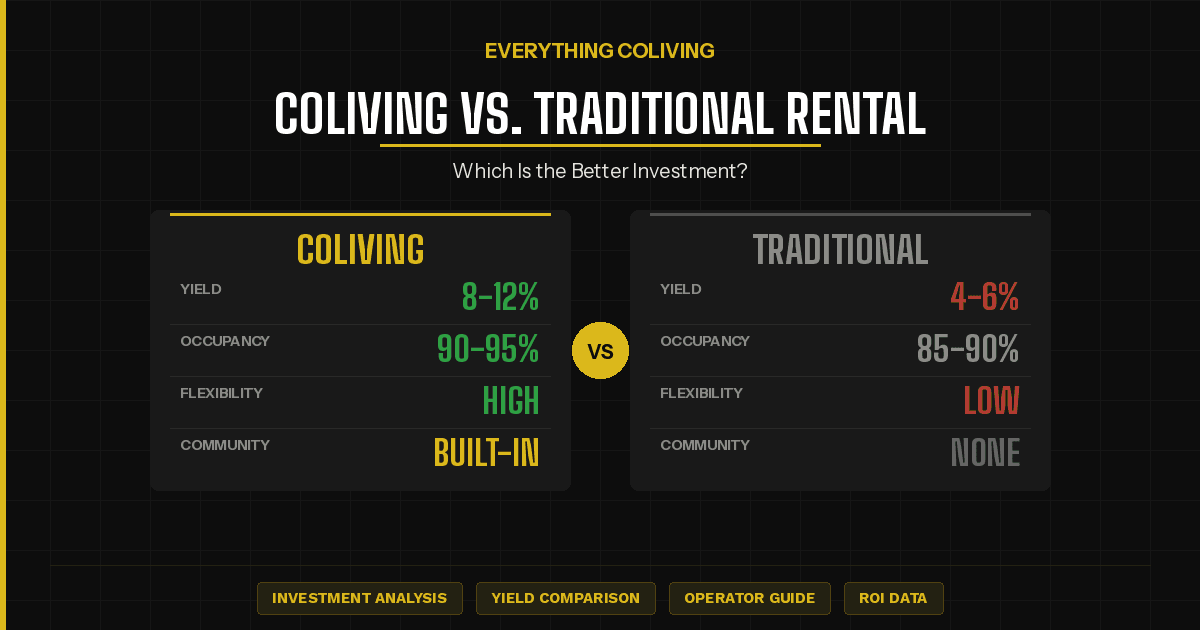
Coliving generates 20–40% higher revenue per square meter than traditional rentals through premium all-inclusive pricing and efficient shared-space utilization. Operating costs are higher (staff, community programming, utilities included in rent), but net margins are typically 5–15% higher. The key advantage is occupancy resilience — coliving spaces maintain higher occupancy through community value and flexible terms.
Should I buy property or master lease for my first coliving space?
For first-time operators, master leasing is almost always recommended. It lets you validate your concept, build operational expertise, and generate cash flow with $50–150K instead of $500K+. Once you have proven unit economics and systems, property ownership becomes more attractive for long-term wealth building. The data shows 46.8% of operators globally chose master leasing — and for good reason.
What financial metrics do coliving investors look for?
Key metrics investors evaluate: occupancy rate (target 90%+), RevPAR trends, EBITDA/EBITDAR margins, CAC and LTV (lifetime value), churn rate, NOI per bed, and cap rate (for property investments). Investors also assess unit economics at the property level, scalability of the operating model, and strength of the brand and systems.
How do franchise/hybrid coliving models work financially?
In a franchise model, the franchisor licenses their brand, systems, and technology to local operators for an upfront franchise fee plus ongoing royalties (typically 5–8% of revenue). The franchisee handles local operations and capital investment. The franchisor earns scalable royalty income; the franchisee benefits from a proven brand and lower startup risk compared to building from scratch.

Coliving Finance & Investment Articles

Deep-dive articles on coliving investment, fundraising, and financial strategy from industry experts.

Free Platform for Operators

List Your Coliving Space on BookMyColiving

BookMyColiving.com is a free platform for coliving operators to list their spaces, generate qualified leads, and grow profitably. No commissions, no listing fees — just direct connections with travelers and remote workers looking for their next coliving home.

FreeNo Listing Fees
0%Commission
DirectLead Generation

Ready to Build Your Coliving Business Model?

Our advisory team has helped 60+ coliving companies build financial models, choose the right structure, and secure funding across 14+ countries.

Join Our Coliving Community on WhatsApp

Monthly masterminds, weekly updates, and networking with coliving operators worldwide.

Join WhatsApp Community