

Recommended Tools
Free interactive tools related to this article.
ROI Calculator
Estimate potential returns and payback periods for coliving.
Try it free →Operating Budget Template
Build a comprehensive operating budget for your property.
Try it free →Pricing Optimizer
Find the optimal pricing strategy for your coliving rooms.
Try it free →Vacancy Cost Calculator
Quantify the true cost of empty rooms in your property.
Try it free →Why Valuation Matters for Coliving Operators
Understanding how coliving businesses are valued is essential whether you are planning to sell, raising investment, bringing in a partner, or simply want to know what you are building is worth. Valuation also helps you make strategic decisions, knowing which improvements increase value and which are just costs helps you allocate capital effectively.
Coliving businesses are valued differently from traditional real estate because they combine property income with an operational business. A coliving is not just a building, it is a brand, a management system, a community, and recurring revenue. This guide covers every major valuation method and what drives value up or down. For fundraising strategies, see our fundraising and investment guide.
Valuation Method 1: Income Approach (Capitalization Rate)
The income approach values the business based on its Net Operating Income (NOI) and the local capitalization (cap) rate:
Valuation = NOI / Cap Rate
Where NOI = Total Revenue - Operating Expenses (before debt service and depreciation)
Example: A coliving generating €180,000 annual revenue with €108,000 in operating expenses has an NOI of €72,000. At a 6% cap rate (typical for coliving in Western Europe), the valuation would be €72,000 / 0.06 = €1,200,000.
Cap rates for coliving typically range from 5-8%, varying by market:
- Prime urban (London, Berlin, NYC): 4.5-6%
- Secondary urban (Lisbon, Barcelona, Austin): 5.5-7%
- Emerging markets (Budapest, Tbilisi, Bali): 7-10%
Lower cap rates mean higher valuations, they reflect lower risk and higher demand from investors.
Valuation Method 2: EBITDA Multiple
For operational coliving businesses (especially asset-light models where you lease rather than own), EBITDA multiples are the most common valuation approach:
Valuation = EBITDA x Multiple
Where EBITDA = Earnings Before Interest, Taxes, Depreciation, and Amortization
Coliving EBITDA multiples typically range from 8-12x depending on:
| Factor | Lower Multiple (6-8x) | Higher Multiple (10-15x) |
|---|---|---|
| Portfolio size | 1-2 properties | 5+ properties |
| Occupancy | Below 85% | Above 92% |
| Revenue growth | Flat or declining | 20%+ annual growth |
| Lease length remaining | Under 5 years | 10+ years |
| Systems and SOPs | Founder-dependent | Documented and scalable |
| Brand strength | Weak brand, OTA-dependent | Strong brand, 70%+ direct bookings |
| Geographic risk | Single market | Multi-market diversification |
Valuation Method 3: Replacement Cost
This method asks: what would it cost to replicate this business from scratch?
Replacement cost includes: property deposits (or purchase price), furnishing and fit-out costs, technology setup, marketing investment to reach current occupancy, time cost of the ramp-up period (lost revenue during months of sub-optimal occupancy), brand value and reputation (reviews, SEO authority, community), and team recruitment and training.
Replacement cost is typically used as a floor for valuation, a business should rarely be valued below what it would cost to recreate.
Valuation Method 4: Comparable Transactions
Looking at what similar coliving businesses have sold for provides market-based valuation benchmarks. Key comparable metrics:
- Price per room: €20,000-€80,000 per room for asset-light businesses, €60,000-€200,000+ for asset-heavy
- Price as multiple of annual revenue: 1.5-3x annual revenue for established operations
- Price as multiple of EBITDA: 8-12x as noted above
Comparable transaction data is limited in coliving compared to mature sectors. The M&A hub provides more resources on coliving transactions.
Free Newsletter
Join 36,000+ coliving professionals
Weekly insights on operations, marketing, and growth, delivered to your inbox.
Subscribe Free →What Increases Valuation
- Long lease terms: A 15-year lease with favorable terms is far more valuable than a 3-year lease approaching renewal
- High occupancy (90%+): Demonstrates proven demand and operational competence
- High renewal rate: Shows resident satisfaction and predictable revenue
- Direct bookings (70%+): Reduced reliance on OTAs = higher margins and customer ownership
- Documented SOPs: A buyer can operate the business without the founder
- Technology systems: Automated operations reduce staffing needs and improve consistency
- Strong reviews: 4.5+ on Google with 50+ reviews builds brand moat
- Revenue diversity: Multiple room types, ancillary revenue (events, coworking day passes)
What Decreases Valuation
- Founder dependency: If the business cannot run without you, it is worth significantly less
- Short remaining lease: A lease expiring in 2 years creates massive uncertainty
- Declining occupancy or revenue: Negative trends scare investors
- Deferred maintenance: A property needing €50,000 in repairs reduces valuation by more than €50,000 (buyers apply a risk premium)
- OTA dependency: If 80%+ of bookings come from Airbnb, the business is one algorithm change away from crisis
- Regulatory risk: Operating in a gray area legally (unlicensed, non-compliant) creates substantial risk discounts
Worked Example
Let us value a hypothetical 3-property coliving operation:
- Properties: 3 master-leased properties in Lisbon, 55 rooms total
- Annual revenue: €660,000 (avg €1,000/room/month at 92% occupancy)
- Operating expenses: €462,000 (70% of revenue including rent)
- NOI: €198,000
- EBITDA: €180,000 (NOI adjusted for one-off costs)
- Average lease remaining: 8 years
- Direct bookings: 65%
- Occupancy: 92%
- SOPs: Documented, operations manager in place
Valuation approaches:
- Income approach: €198,000 / 6.5% cap rate = €3,046,000
- EBITDA multiple: €180,000 x 10x = €1,800,000
- Per room: 55 rooms x €40,000 = €2,200,000
- Revenue multiple: €660,000 x 2.5x = €1,650,000
A reasonable valuation range for this business would be €1,800,000-€2,500,000, with the exact figure depending on negotiation, buyer type, and market conditions.
When to Get a Professional Valuation
- Selling the business: Always get a professional valuation before listing or entering negotiations
- Raising equity investment: Investors will do their own valuation, but knowing yours sets the anchor
- Bringing in a partner: Fair valuation protects both parties
- Insurance purposes: Ensure adequate business interruption coverage
- Annual planning: Tracking valuation growth helps you measure long-term value creation
Professional business valuations for coliving operations typically cost €3,000-€15,000 depending on complexity. For simple internal valuations, the methods above provide reliable estimates.
Frequently Asked Questions
Which valuation method is most commonly used for coliving?
EBITDA multiple is the most common for asset-light (master lease) coliving businesses. The income approach (cap rate) is more common when the operator also owns the property. In practice, most transactions consider multiple methods and arrive at a blended valuation.
What EBITDA multiple should I expect for my coliving?
Single-property operations with under €100,000 EBITDA typically see 6-8x multiples. Multi-property operations with strong systems, 90%+ occupancy, and €200,000+ EBITDA see 9-12x. Portfolio-scale operations with institutional-grade reporting and proven scalability can achieve 12-15x from strategic buyers.
How do I increase my coliving's valuation?
Focus on the factors that drive multiple expansion: grow to multiple properties, document all operations so the business runs without you, shift bookings from OTA to direct channels, secure long-term leases, maintain 90%+ occupancy consistently, and build a strong online reputation. Every improvement in these areas compounds into higher valuation.
Can I value a coliving that has not yet reached profitability?
Yes, but with difficulty. Pre-profit coliving businesses are valued on: replacement cost (what has been invested), revenue trajectory (growth rate), and comparable transactions. Expect a significant discount compared to profitable businesses. Investors value potential but price in the risk of reaching profitability.
Written by
Admin
Admin is a contributor at Everything Coliving, the leading growth platform for coliving operators worldwide. Everything Coliving has been featured in 50+ publications including Forbes India, BBC Punjabi, and Financial Express.
Explore Related Topics
Free Tools
Further Reading
Related Articles

Tax Deductions Every Coliving Operator Should Know
Maximize your tax savings with this guide to deductions specific to coliving operators, from furnished unit depreciation to community event expenses.
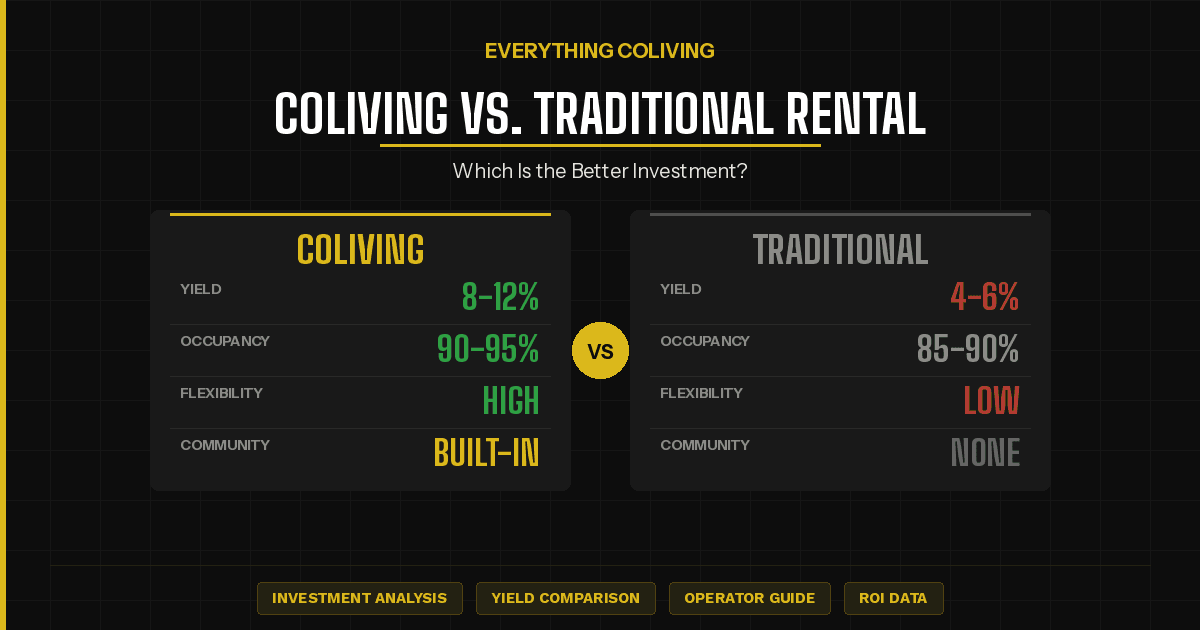
Coliving vs. Traditional Rental: Which Is the Better Investment?
Compare the financial returns, risks, and operational demands of coliving investments against traditional buy-to-let properties.

Coliving Unit Economics Cheat Sheet: CPOR, ADR, RevPAR Explained
A clear explanation of the key financial metrics every coliving operator should track: CPOR, ADR, RevPAR, NOI, EBITDA, and how to calculate and benchmark each one.